
Our Vision
Is to produce secure, reliable, affordable, climate-resilient water supply.
Our Mission
Is to develop the people, knowledge and partnerships needed to transform Australia’s water systems for a climate-resilient future.
Our Why
Australia’s water supply systems are under growing pressure from climate change, population growth and rising energy demands. Rainfall is becoming more variable, droughts and floods more intense, and evaporation rates are increasing. As a result, the reliability, affordability and sustainability of water supplies are declining—at the same time demand continues to grow.
Responding to these challenges with conventional infrastructure alone will not be enough. Building climate‑resilient water systems requires a step‑change in how we plan, govern and manage water across cities and regions.
The ARC Training Centre for Climate-Resilient Water exists to build the capability, confidence and collaboration needed to drive that transformation.
We focus on strengthening the people and institutions that shape water systems—not promoting any single technology or solution. Our work is grounded in three complementary ambitions:
- Strengthening collaborative governance
Enabling better coordination across organisations, sectors and scales so decisions account for the whole water cycle, shared risks and long‑term outcomes. - Adapting existing centralised water supply systems
Helping utilities and regulators find flexible, low‑risk pathways to improve the performance, resilience and efficiency of current systems under changing climatic conditions. - Creating future water precincts
Supporting place‑based approaches that integrate water, energy, environment and urban development to deliver resilient, circular and locally appropriate water services.
We recognise that many of the barriers to climate‑resilient water systems are not technical. Policy fragmentation, regulatory constraints, social licence, planning processes and skills gaps often limit the uptake of innovative approaches, even where solutions are proven internationally.
Our Centre brings together researchers, industry partners and practitioners to address these challenges in an integrated way—combining insights from governance, infrastructure, data, economics, energy and environmental systems. Through applied research, training and real‑world design challenges, we equip the next generation of water leaders with the interdisciplinary skills and networks needed to deliver change at pace.
By building shared understanding and practical capability across the sector, the ARC Training Centre for Climate-Resilient Water aims to support the transition to reliable, affordable and climate‑resilient water systems for Australia’s future.
What we are doing
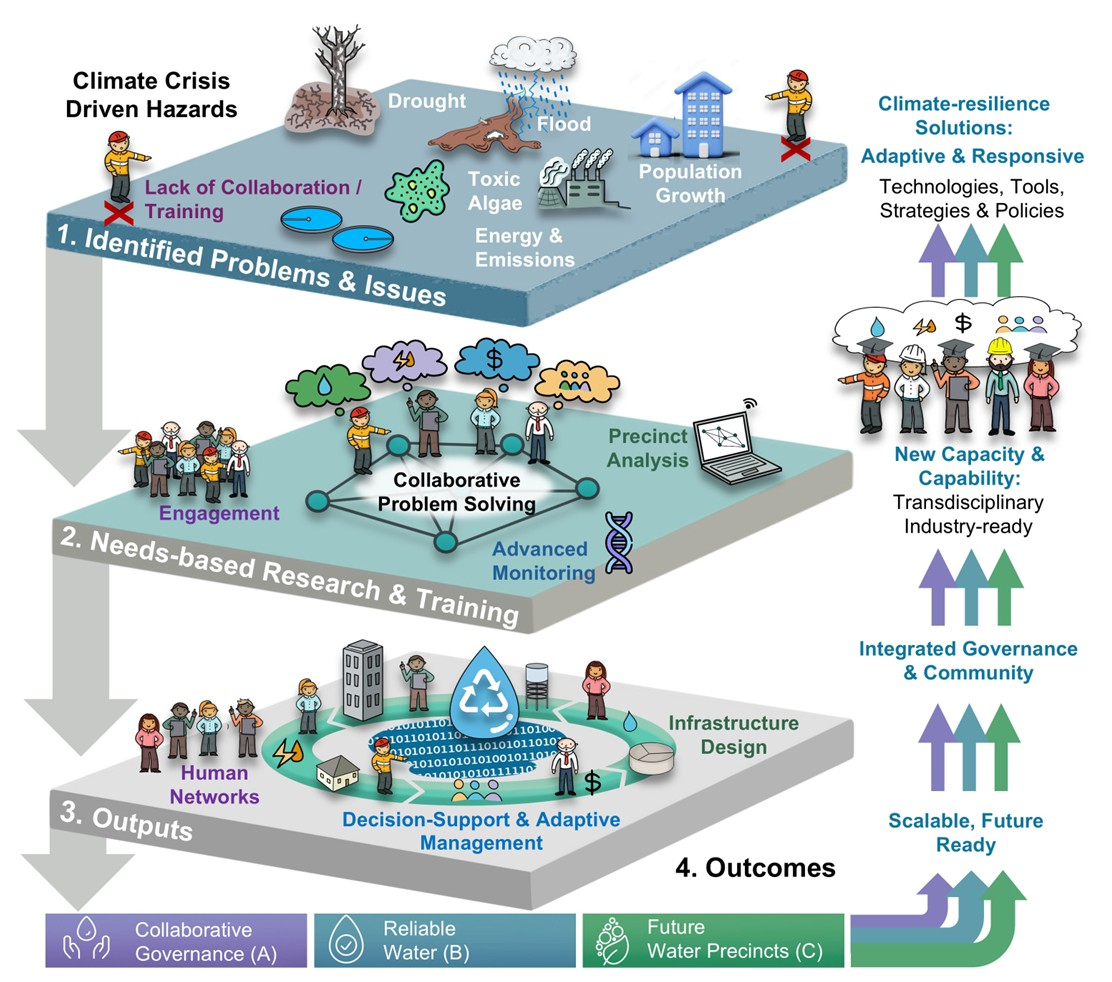
We are taking a whole‑of‑system approach to transforming Australia’s water future. Starting with the real and growing risks driven by climate change, population growth and rising energy and emissions, we bring together industry, government, communities and researchers to clearly define the problem. From there, we deliver needs‑based research and training that supports collaborative problem‑solving, advanced monitoring, data‑driven analysis and precinct‑scale thinking. By translating this work into decision‑support tools, adaptive management, infrastructure design and strengthened human networks, we build the capabilities needed to deliver integrated governance, reliable water services and climate‑resilient solutions that are scalable and future‑ready.
The Centre’s research and training program is organised under three themes addressing key questions. Each are shown below under the problems (level 1), centre activities (level 2) and outputs (level 3). Collectively, and with the Training Program and Design Challenges, they create the outcomes including new capabilities and skilled people needed to find solutions to these challenges.
Our objectives
- Advance Climate-Resilient Water Solutions
Collaboratively develop and use innovative technologies, infrastructure designs, and management strategies to secure reliable, affordable, and low-emissions water supplies.
- Transform Governance and Policy
Create adaptive governance frameworks and regulatory models that enable wider adoption of water recycling, stormwater harvesting, and circular water systems.
- Build Future Water Leaders
Train and equip the next generation of transdisciplinary professionals with the technical, social, and leadership skills needed to drive systemic change across the water sector.
- Integrate Water, Energy, and Emissions Management
Reduce energy use and greenhouse gas emissions by embedding water-energy nexus research, efficiency strategies, and Scope 3 emissions management into practices.
- Foster Partnerships
Strengthen collaboration across academia, industry, government, and communities — including First Nations voices — to build trust, social licence, and collective solutions.
- Accelerate Australia’s Transition to a Circular Water Economy
Design and implement precinct-scale solutions that recycle wastewater, harvest stormwater, and integrate renewable energy to support sustainable urban growth and competitiveness.
- Deliver Tangible National and Global Impact
Translate research into practice through demonstration projects, training, and industry partnerships, ensuring benefits for Australia’s $24B water sector and global water security.